Showing posts with label Absolute Africa. Show all posts

Sunday, October 23, 2016

Trekking The Mountain Gorillas

The guide spotted the problem straight away. “You’re older than the rest,” he said bluntly, not meaning to offend, just looking out for me, when he suggested I join the “easier” trek.

So even though I opted for the shorter, flatter trek, as opposed to the longer, steeper climb, I almost died! That’s a little dramatic! Okay, my heart and lungs almost exploded! My thigh muscles were on fire! (Still too dramatic?)

We climb and climb and climb as we set out in the “impenetrable” lush rainforest of the Bwindi/Mgahinga National Park in Kisoro, Uganda. Straight away I am panting and puffing, struggling to breathe, my heart racing, drenched in sweat, my tee shirt soaked, my glasses fogging up, as I lean on the long walking stick for support, my backpack weighing heavy, trailing behind my fellow hikers.

I have seriously overestimated my fitness level. I’m used to walking the dogs in the flat woodlands near our home in rural Kent or strolling around National Trust gardens. But this uphill hiking is shocking my system into overdrive!

A seven-man support team; four guides, one porter and two police guards with rifles to fire shots to scare off elephants, if we should stumble across them, accompany our small group of four trekkers from the Absolute Africa tour. The men are so patient, kind and helpful in guiding us on this quest to see the Mountain Gorillas in their natural habitat.


We started this once-in-a-lifetime day at 5 am. A quick breakfast at 5.30, we set out at 6 am for a two hour drive through the most idyllic beautiful country of velvet hills, a brown and green patchwork of intricate hillside farming with fields of bananas, potatoes, yams, wheat, maize, corn, string beans on bunches of sticks and bushes of flowering peas carved into the steep inclines.

We drive through flourishing villages, alive with morning activity, men and women off to work, smiling and waving, and children resplendent in their school uniforms rushing at the van, laughing and squealing. My heart expands with joy and pure bliss to experience such warmth and friendship as we sneak a glimpse into the lives of these hardy, peaceful, mountain people.    

These fertile hills and valleys of rich soil grow the food basket of southern Uganda, a region which in recent years has also come to embrace eco-tourism with an array of delightful lodges for visitors from around the world who come to view the magnificent mountain gorillas up close and personal. The new conservation industry provides purposeful employment for the locals, keeping their youth at home in this natural paradise, rather than seeking work in far-off cities.        
We climb forever (or so it seems to me) after numerous stops for me to catch my breath, before our lead guide, Onesmus tells us we are about to descend into the valley. We ease ourselves downward through slippery, muddy tracks finding footholds on rocks.


 I take off my foggy glasses and everything becomes a blur. I drop my watch and step in a squelchy puddle, my brand new hiking boots are covered in mud. Onesmus is holding my hand to stop me from falling. He’s graciously taken my heavy water bottle and backpack.

I am using my walking stick to keep steady and the gloves allow me to grab the branches and bushes as we go deeper into the valley in search of the family of eight gorillas foraging there. One guide is using a machete to clear a path.  Luckily none of us has been stung by fire ants or stinging nettles!

And on the bright side, the weather in the rainforest is perfect for trekking today. Many people brave this trek in drizzle or even torrential downpours. But my big green raincoat is still tucked away in my backpack and the humid air is not unbearably hot and steamy.   

Suddenly we hear a deep guttural roar and Onesmus says it’s the Silverback. We are close. It’s unbelievable! Is this possible? Our little group of tourists, a couple from Scotland, a young woman from Australia and me from the UK, are about to witness the endangered Mountain Gorilla, the largest of all the apes, in the wild.


We see the massive Silverback. He’s drinking from a stream and a cheeky juvenile is playing nearby. And then a mother carrying her baby joins him. Onesmus says the male baby is one year old and still suckling from mum.

We watch in awe, just metres away. The Big Guy is cool. He’s seen curious humans before and as long as we stay a respectable distance from his family he will tolerate us, without threatening displays.

They move to a shady spot to sit and munch on branches and leaves. The adults are so relaxed that, as their fibrous meals hit their big bellies, they release long slow farts! We all giggle at this surprising, comical sound!

The others have zoom lenses and are capturing brilliant close-ups but I am using my Iphone and snapping a few good poses as these magnificent gorillas look into the camera with their deep, soulful eyes.


We can hear the juvenile whimpering in the bushes. Onesmus explains that his mother has just weaned him as he’s now four years old and he is protesting. He wants to feed from her. It will take some time before he accepts he’s now destined for a 98 per cent herbivorous diet of branches and leaves, with a few fire ants and insects thrown in for a little protein boost!

The baby decides to climb up the tree, exploring the top branches, practising his gymnastics and stretching his long arms to swing through the branches, but he misjudges and falls right in his mother’s lap! We gasp as he lands with a thud. He sits up, unhurt, but I swear he looks a little embarrassed!

And then mum leans across to groom the Silverback, carefully picking off fleas and nits. This is such an intimate social behaviour to witness. Apparently such a favour is reciprocal as Onesmus explains, the Big Guy will also groom her and delight in eating the bugs he finds!

Before we set off on the trek, we enjoyed a talk about the Mountain Gorillas in one of the National Park’s immaculate huts and learnt that there are only three apes on Planet Earth; gorillas, chimpanzees and humans!

The gorillas’ social behaviour, bonding to the family group and devoted parenting seem to be so close to our own. In fact we share 97 per cent of our genetics with our ‘grand cousins’.

Tragically, the Mountain Gorilla, the largest of the apes, was pushed to the edge of extinction through hunting for food and trophies. In 1991, this 331 square kilometre National Park, a World Heritage Site, began to work desperately to increase the numbers.

The park is home to more than half of the remaining gorilla population, with others living in reserves in neighbouring Rwanda and the Democratic Republic of the Congo (DRC).

Onesmus explained that the National Park was gazetted in 1991 and tourism started in 1993. In 1996, the gorilla numbers were as low as 320 and when they were counted in 2011, the number had risen to 400.

The gorillas are slow breeders. Each female starts to have babies at the age of eight, usually only one baby, occasionally twins. The baby breastfeeds for four years before she weans the youngster and gets pregnant again.
The males mature and grow their trademark silver hair on their mighty backs around the age of four, when they start to mate. A dominant Alpha Male will head up each family group. The gorillas live for 45 to 50 years.

How fascinating to learn about these wonderful great apes and to know that dedicated conservation work and responsible eco-tourism is succeeding in saving the endangered species. The money we paid for the trek goes towards the vital conservation work.

I can’t believe I survived the return trek, clawing my way up through the thick overgrown valley, helped by the attentive and patient guides, one gripping my hand, the other pushing my fat behind! Once we hit the home stretch we stopped for a lunch - stale cheese sandwiches, a fistful of crisps and swig of water for me!


Our Gorilla Trek was four and a half hours and cost £460 and worth every penny and every aching muscle. 


Wednesday, October 19, 2016

Game Drives on the Serengeti and the Joys and Challenges of Camping

Returning from the Masai Mara plains to the Big Smoke of Nairobi, after a harrowing nine hours on the road, culminating in a delirious karaoke session of Bless The Rain Down in Africa and Lion Sleeps Tonight and, too exhausted to put up tents, we all opt for an upgrade to a hostel. Sunday dawns and we pick up three extra passengers, Steve, a meteorologist from London and Pam and Michael, a thrill-seeking couple from Scotland doing a world trip!

After travelling across the border to the bustling city of Arusha in Tanzania, on Day Five of our Absolute Africa tour, we pick up five Canadian lads who have just climbed Kilimanjaro who regale us with tales of hiking the famous mountain. When we arrive at the camping ground, a dramatic change occurs!

We switch vehicles from the big yellow bus, our mobile lounge room, to a smaller safari vehicle with canvas roll-up windows. We change crew from our happy-go-lucky tour leader, Edmund with his cheerful motto “Let’s make a plan” and our pensive driver Stephen to a new commander-in-chief, Joe, a stocky, athletic guy with a direct approach and “No guarantees” (about hot showers) and our new driver Patrick, with his beaming smile and relaxed Reggae style! 


And we combine with another tour group to become 17 passengers in total.
 The transition is a mild shock that night at the Arusha campsite when three tour groups converge and our small team is assigned to cook for 29 famished travellers! (an additional 12 are heading in another direction).

A Camp Feast

Edmund and I rise to the challenge to become Camp Cooks Extraordinaire and swing into action with Merethe and Julio pitching in with gusto. I’ve never chopped up so much coleslaw in my life! Other helpers peel a giant mound of potatoes for mash and enough carrots and beans to feed an army and Edmund makes a mountain of rice and chicken. What a feast!

Monday morning, we meet our new travelling companions, Nathan and Priya, a charming Indian couple on an exciting world trip, Rachel and Paul, high flyers from London, Barry, a burly Aussie, Yan from Canada, Hannah and Olga from California and Danielle, a Aussie nurse who’s been on the tour since Cape Town.

Joe announces we have a roster for cooking, clean-up, security and truck duty. We need to go shopping for food supplies before we hit the road so my team and I frantically search the aisles for Mexican ingredients. When we can’t find tortillas we improvise with Indian chapattis and grab bags of cassava chips instead of corn chips for nachos! With mincemeat, red kidney beans, tomato paste, chilli and a massive bag of avocadoes, we’re good to go.


Finally we set off through the rolling countryside of Tanzania, passing through little townships, waving back at happy, laughing children, heading for the Ngorongoro Crater, to experience a unique game drive in this spectacular volcanic caldera formed three million years ago, which offers an ideal, protected eco-system to many species.

The term ‘game drive’ originated when hunters with their sinister guns would go out in search of  ‘game’ to shoot and kill. Thankfully these days most people just want to shoot these beautiful animals with their camera.

The landscape of the crater is eerie, like another planet! In our jeep, we spot three lions and three lionesses eating a warthog surrounded by opportunistic hyenas and a jackal, hoping to steal some fresh meat and later in the tranquil jade green lake, we marvel at the sight of a school of basking hippos, while a solitary elephant forms a magnificent silhouette against a mountain backdrop.


Incoming Rain

Day Seven, on the road to Serengeti is abysmal. We bounce along rough roads for endless miles when the sky opens up and pours with rain so heavy that water is pelting through the canvas sides. We all sit in the vehicle in our raincoats trying to squint through the haze and spot animals but they have all gone into hiding and our game drive is a washout! 


Tired and hungry and keen to get to our camping ground, a tanker accident on the track blocks our way for an hour.

When we finally set up our tents in the pitch dark, everyone is ravenous and tonight is our turn to make our Mexican feast. So we crack on and finally feed the hungry hoards our African-Indian-Mexican fusion capped off with Julio’s delicious guacamole! I crawl into my sleeping bag, exhausted.

Elephants At Breakfast

After the rain, we wake up to a sparkling, perfect morning with elephants grazing near our campsite! What a promising way to start the day, which turns out to be magical – safari gold! The animals are out in force, grazing on fresh, moist grass and prancing and playful as we drive across the famous Serengeti; a national reserve, Joes tells us, is 14,763 square kilometres and as big as Holland!


We sight an abundance of zebras, gangling giraffes munching n treetops and a herd of old cape buffalo carrying cheeky yellow billed ox peckers on their backs!


Joe is in his element sharing his knowledge of wildlife and tells how the old, “bachelor buffaloes” hang out together, when past their prime, they are rejected by the fit, young herd.


We are all so exuberant today to be in true safari-mode with zoom lenses at the ready. The Serengeti boasts a population of 5000 lions and we are itching to spot the big cats.

Then it happens. Dozens of jeeps are stopped on the track with eager tourists glued to cameras poking out the rooftops and windows captivated by some unfolding drama. The frantic scene is like the paparazzi of the animal world with the Big Cats the sought-after celebrities.


Mother Lion Reprimands Cub

As we draw closer, we see a female lion pacing the road while two other lionesses guard five feisty cubs sitting obediently on a log. 
We see Mum drag her kill, a small gazelle, under a tree, where a leopard is draped in the overhead branches. She calls to the cubs with a low growl and four of them come scampering for lunch and settle in to eat while she keeps watch. She calls again to the tardy cub who bounces towards his mother and she gives him a good swipe on the head and roars, reprimanding him, as if 
to say” “Come when I call!” The other two females continue to keep watch while all the cubs feed.

What an extraordinary and thrilling drama to see played out in nature! I have to pinch myself! We are privileged to witness this little scenario happening in real-life, not sitting on the sofa watching a TV wildlife show!


Joes explains that female lions live and hunt together caring for a collection of cubs that can belong to the different mothers while male lions usually leave the pride after mating and roam around as solitary hunters or team up with other males.

We stop at the Serengeti tourist centre for lunch. Then five minutes before the bus is about to leave, Julio and I behave like naughty children running off to buy souvenirs and delay our departure, much to everyone’s disapproval.


The Leopard Encounter


I am standing at the front of the bus when we approach a few vehicles stopped on the track with binoculars and cameras glued to a small bush. I spot her first! A leopard! She is motionless, transfixed, staring at something in the distance. Everyone is lined up along at the open windows to see what’s happening. In a flash she pounces and strikes the helpless gazelle in the neck. We are gasp and shriek! Oh My God! We just witnessed a kill - the Serengeti’s ultimate thrill! I feel sorry for the gazelle, which had obviously wandered off from the safety of the herd. Isolated and vulnerable, he was easy prey for the lightening fast wild cat.


Now the leopard is poised clutching the gazelle in her powerful jaws as our cameras click this incredible image but she is shy and nervous about the human audience so drags the dead gazelle under a bush to eat in peace. 

I admit it was irresponsible to hold up the bus buying souvenirs, but I like to think the fateful delay led us to seeing the leopard kill! If we’d been 20 minutes earlier on that road we would have missed this thrilling spectacle!

A Serengeti Thunderstorm

We arrive at the rustic Bush Camp, with its rusty iron toilet and shower block and rickety old shelter shed in the early afternoon, delighted to have time to wash our dirty clothes and hang them out in the sweltering sun.

The hot sun is like a sauna and we strip down to shorts, singlets and sunnies for cool drinks. Some opt for invigorating cold showers, others are hard at work scrubbing clothes in plastic dishes.

A small group heads off for a guided nature walk and others stroll to the nearby luxury lodge for drinks on the deck.


But the idyllic interlude is short-lived. Gunmetal clouds are gathering overhead. We grab the clothes from the lines and relocate them under the shelter and Joe is going around securing all the tents with pegs. I zip up the front of our tent and flee to the dilapidated shelter. And then it happens.

The rain teems down with frightening force, coming in sideways under the shelter. The strung-up laundry is flapped around and saturated. Three camp rangers seek cover but they are unfazed by the familiar torrential rain. We watch wide-eyed as the camping ground is rapidly submerged under a foot of water. 

The nature walkers return to join us in the shelter, two girls have sought refuge in the bus, Joe and Patrick are waiting out the storm in the cabin and the rest of our travellers are watching the show at the Lodge.

The deluge, thunder and distant lightning lasts for an hour and abruptly stops. I realise I forgot to zip up the back window of our tent and discover that one of the mattresses is soaked. Staring at the prospect of sloshing around in a waterlogged camp and sleeping in a wet tent, in a moment of panic, I want an upgrade to the safety of the luxury lodge! But lovely Patrick gives us a fresh mattress and the water miraculously recedes.

That night the cooking team, Priya, Yan, Danielle and Merethe cook up a scrumptious feast of stir fry veggies and chicken and we have a sing along in the rusty old shelter. After the storm, all is well in the camp again. 


The Challenges of Camping

*Taking cold showers

*“Drying” myself with a smelly, damp towel

*Running out of clean undies!

*Finding something to wear from a bag full of filthy clothes

*Obsessing over rummaging through my bags and sorting out stuff

*Giving up make-up

*Dirty fingernails

*Gashing my thumb on the truck’s metal locker, and being covered in a colourful assortment of bruises and cuts

*Getting sick from driving for hours on bumpy roads

*Catching my hair on the zip of the tent (every time!)  

*Putting up the tent in the dark and putting down the tent in the dark before breakfast at 6 am.

*Wishing I had a head torch

*Stopping the bus on a dusty track for us girls to squat behind a bush while the guys go on the other side

*African toilets (say no more!)

*Hearing scary heavy rain on the tent!

*Scrambling to find my hiking boots and raincoat

*Wishing I’d brought my Canon camera and zoom lens for better close-ups of wildlife

The Joys of Camping

*Cooking outdoors on an open fire for hungry travellers

*Sitting around a campfire, gazing at the mesmerising flames, with the smell of smoke in the crisp night air

*A chorus of bird song at dusk

*Looking up at a vast African night sky ablaze with sparkling stars

*Finding zebras and elephants outside our tent

*The smell of the rain

*The relief of having brought a raincoat only yesterday!

*Climbing into a sleeping bag

*Lying snug inside and listening to gentle rain on the tent

*Making deep friendships by experiencing real adventures together

*The private bliss of riding along in the back of the bus, watching spectacular scenery roll by, waving at happy children, while listening to my favourite music through earplugs, snuggling next to my buddies.   


Game driving is exhilarating and addictive. I’ve developed a taste for seeing animals in the wild and a taste for camping, tents and campfires. The joys of this adventurous outdoor lifestyle far outweigh the challenges.


Sunday, October 16, 2016

Making Friends with Maasai Men


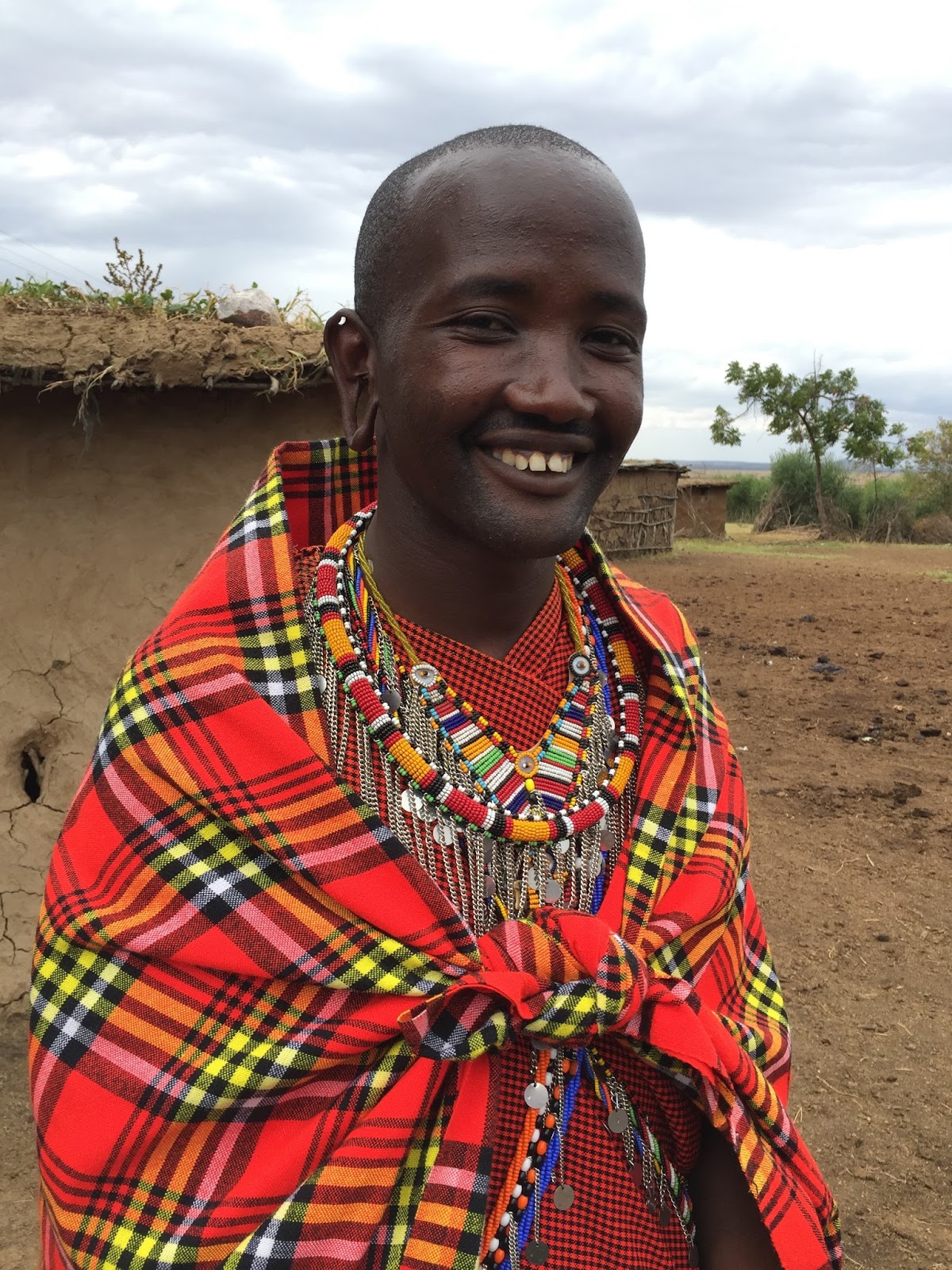
My fascination with Maasai men and their culture all started with George. A handsome young Maasai warrior with big loops in his ear lopes, dressed in a dazzling orange and yellow check Maasai blanket and tunic and adored with intricate bead necklaces, George, the son of the chief, was our eloquent host when we visited the Maasai village on the second day of our dramatic tour with  Absolute Africa


Jumping off our massive yellow bus with relief after a gruelling three-hour ride on a bumpy dirt road, the five of us weary travellers are warmly greeted by exuberant, resplendent Maasai men dancing and singing and leaping high in the air, as if on the bouncy pogo sticks I remember from childhood. 


The enthusiastic performance sure wakes us up! And then George leads us into the village; a collection of mud huts surrounding a large round yard and pens for cows, goats and sheep. A huddle of men demonstrate starting a fire without matches (a handy skill they share with the Aboriginal people of my homeland Australia and all clever boy scouts!)

George explains that the proud Maasai tribe that extends across a vast territory north and south of Nairobi in Kenya, right into Tanzania are nomadic herders who graze their livestock far and wide. The Maasai revere their cherished cows relying on their milk mixed with their blood for food. They also eat goat and sheep meat and these days supplement their high protein diet with vegetables bought at the markets.

George says brides command a bride price of 10 cows, five sheep and 10 blankets and traditionally the tribe has been polygamous. George’s father has six wives and many children comprising a big happy blended family. However George, a modern young man in his 20s, is content with one wife, Evelyn, a savvy businesswoman who runs the craft shop, and they have five children. George is also a pastor so Christianity is now modifying Maasai beliefs and practices.


George guides us into one of the tiny mud huts, which are hand built by the women, and shows us the miniscule beds where a wife and children sleep, with the husband rotating around the huts each night to sleep with each wife.


Next the beautiful women in their colourful dresses gather to perform a song and dance and we clap and sing along to show appreciation. Next stop is a huge circular thatch-roofed hut overflowing with enticing jewellery and trinkets and coveted Maasai blankets. I’m mesmerised trying to choose bracelets and necklaces to take home as gifts for my family.


William came for me at 5am before dawn, when I spilled out of my tent, a dishevelled mess. His job was to drive me to the hot air balloon launch site. So we sat quietly in the powerful Land Rover as this handsome man in his 30s, drove adeptly along the familiar roads of his tribal land of breath-taking beauty, pointing out animals stirring from their morning slumber.

As I arrive to see the massive striped balloon lying limp on the ground in preparation for lift out, I’m nervous with trepidation, when William glances down and kindly points out that my shoes are on the wrong feet! We have a good laugh and he waves me off, saying he will collect me after breakfast to transport me to the luxury lodge to rendezvous with the rest of my group. With no idea where I am, in the middle of nowhere, I have to simply trust my new friend, feeling intuitively that I am in safe hands.

True to his word, William shows up at our elegant breakfast on the open plains after my spectacular hot air balloon ride across the Maasai Mara. (read my previous post for details!) As we bounce along, to my delight and surprise, William spontaneously decides to take me on a personal game drive to spot some of the Big Five.

I cannot believe our luck when we stumble across a family of beautiful cheetahs, languidly luxuriating in the sunshine, draped on a mound under a scraggy bush. There’s mum, blinking and smiling, and four playful cubs posing for a family portrait! I pretend I’m David Attenborough and make a little video with a voice-over, which William finds highly amusing!

And then William steers us to a creek bed where we spot a huge male lion lying on his back with his giant paws in the air, his belly heaving with each breath. Williams explains that the lion has just feasted on a kill and is lazing around digesting his meal, in the exact same pose my cocker spaniel Honey takes when she wants a tummy rub.

I tease William by saying “What would happen if I got out and gave the lion a tummy rub?” If a black man’s face could turn white! I swear William’s shocked expression was imaging the beast having me for dessert and how would he explain that to the boss? “I’m only joking,” I say, and we share a laugh at dumb tourists! A few metres away down in the creek bed, we see the lion’s female mate also resting in the shade so we leave them in peace and head off.

Driving along, I chat with William about his family. He is the proud dad of six children and he has ambitions of a good education for all his daughters and sons so they can get good jobs and expand their opportunities and embrace a contemporary lifestyle.

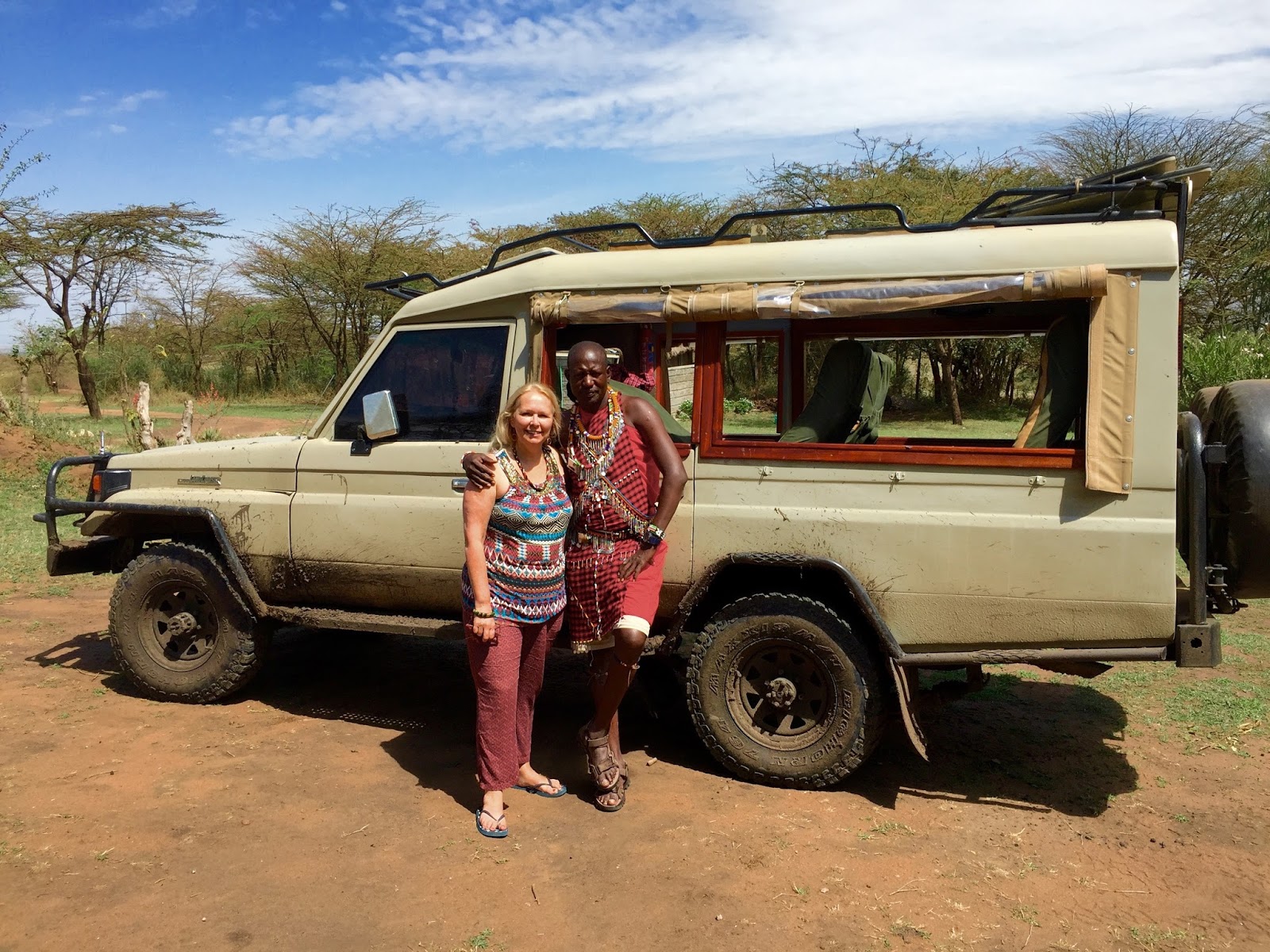
After a photo together and exchange of email addresses, William leaves me at the lodge. I’m hoping for a hot shower and fresh clothes but my travelling buddies hustle, saying there’s no time before the next exciting adventure.   


After getting sick with the bumpy ride in the back of the jeep yesterday, the others suggest I ride up front with Peter, our experienced Maasai game driver.

First we spot dainty gazelles scampering along, their little tails wagging, then two adorable baby warthogs galloping after their mother, elegant Topi antelope with their impressive horns, herds of wildebeest, their heavy heads chomping on grass with their fine veil of whiskers blowing in the breeze! And there’s an abundance of zebras huddled together. The mature ones, dramatic in their black and white stripes, groom each other’s bristly necks while the brown and white youngsters prance and cavort!


As we drive towards the famous Mara River, with the pure hot sun beaming through my side window, I glance across at Peter’s profile and ask about the big loops in his ear lopes. He happily explains that the hole was cut as a boy, and gradually expanded by wearing bigger and bigger sticks and he adds that the droopy adornment can be worn “out or tucked in!”

He points to a scar on his muscular black arm, in the shape of a paw print and explains he got this when he killed his first lion… and then another scar on his right arm and others on his thighs. Peter explains he has killed seven lions in total since he was 15, acts of life-threatening courage and bravery, which earned him the role of Chief. I am astonished to discover I am chatting casually with a highly respected Masai chief and that he has opened up freely about the tribe’s manhood rituals.

He says the Kenyan government has now made it illegal for Maasai warriors to kill protected lions in the Reserve so this ritual has recently come to an end.

Peter is wearing many lavish necklaces to signify his status as chief. His surname is Narok, the name of the bustling town we passed through; his ancestors’ name. The family owns 190 acres of land and a guest lodge for international visitors. I am gob smacked! He kindly invites me to come and stay and experience the Masai way of life! Wow! Now that’s an offer I will take up!

Here is an amazing Maasai man successfully blending traditions with 21st century business skills and technological know-how. His smart phone fits nicely under his robes!

And then Peter expresses his hopes and dreams for his six daughters. He is putting them all through higher education and university qualifications. His eldest girl wants to be a pilot! What wondrous changing times for rural Africa!

After a picnic lunch on a Maasai blanket, we discover the Mara River is teeming with hippos and crocodiles and watch a herd of zebra stand transfixed on a cliff staring into the swirling waters below, seemingly contemplating whether to cross the treacherous river to reach the fresh pasture on the other side. They appear to be weighing up the risks of being killed and eaten by ferocious crocs as against the lure of the greener grass! The leader of the herd edges closer and the others follow. They stand and pause then all of a sudden change their minds and retreat. What a spectacle to witness!        


When we break camp at the Maasai camping ground the next morning, I get to ride in the cabin with Stephen for a slightly smoother ride than in the back of the bus, being thrown around during the three-hour trip on the rough, unmade road to Narok.


I had no idea our shy, quiet expert bus driver Stephen is also a Maasai man. He is a brilliant driver navigating countless potholes and rocks with unwavering concentration on this dangerous road. He does this demanding job to support his precious family; his wife, Lily, a primary school teacher, and his three young children, whom he’s missing, especially his baby!

Stephen lives on Maasai farmlands owned by his family, 30 miles south of Nairobi. I am surprised to discover that Maasai lands extend south of the city. When the British colonised Kenya and established Nairobi as the capital they had no regard for carving up tribal territories.

As we drive along forming an unlikely friendship across our two different cultures, Stephen extends a warm welcome to me to visit his family on my next trip.

There is much more to learn about the intriguing Maasai people and I know in my heart I will return.